
Welcome Back!
In my last post, we talked about volcanoes on Earth. During our talk, the term plate tectonics was introduced. Hence, to further solidify our understanding of volcanoes, I thought why not explore this topic… rather scientific theory.
Here goes…..before plate tectonics, there was “continental drift” a theory first proposed by scientist Alfred Wegener in 1912, which provided no explanation of how the continents could move around the planet; however modern research, “plate tectonics” do.
According to Encyclopedia Britannica;
The concept of Plate Tectonics was formulated in the 1960s. From this theory it was derived that the Earth has a rigid outer layer, known as the lithosphere which is typically about 100 km (60 miles) thick and overlies a plastic (moldable, partially molten) layer called the asthenosphere.
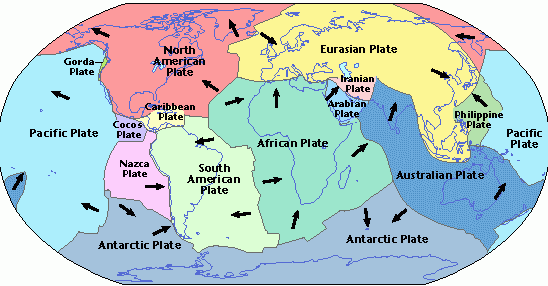
The lithosphere is broken up into seven very large continental- and ocean-sized plates, six or seven medium-sized regional plates, and several small ones. These plates move relative to each other, at about 5 to 10 cm (2 to 4 inches) per year, and interact along their boundaries by converging, diverging, or slipping past each another. These interactions are thought to be responsible for most of Earth’s seismic and volcanic activity, although earthquakes and volcanoes can occur in plate interiors. Plate motions cause mountains to rise where plates push together, or converge, and continents to fracture and oceans to form where plates pull apart, or diverge. The continents are embedded in the plates and drift passively with them, which over millions of years results in significant changes in Earth’s geography.
Check out this video!
According to the World Atlas there are nine major plates; North American, South American, Pacific, Eurasian, African, Indo- Australian, Australian, Indian and Antarctic.
Though small in size the minor plates are equally important in the shaping of Earth, such as the tiny Juan de Fuca plate which is largely responsible for the volcanoes that dot the Pacific Northwest of the United States.
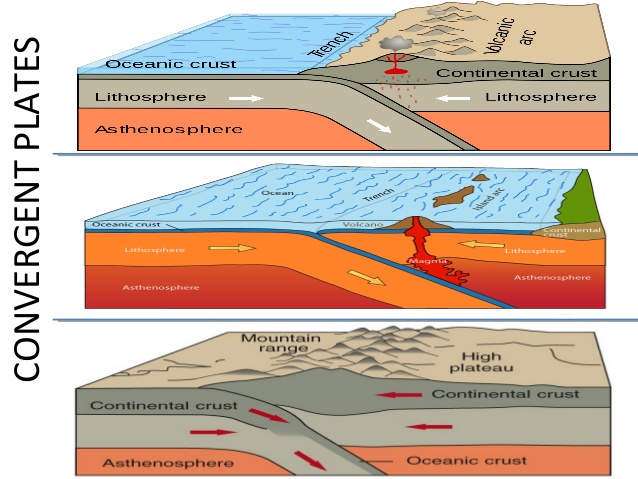
The movement of plates creates three type of tectonic boundaries; convergent, divergent and transform boundaries.
Convergent Boundaries
These boundaries are created when plates move into one another, causing the crust to crumple and buckle into mountain ranges such as that of the Himalaya, which was believe to have been created over 55 million years ago when India and Asia crashed into each other. Convergent boundaries also occur when the ocean plates dives under a landmass in subduction, as the overlaying plate is lifted it also forms mountain ranges.
Divergent Boundaries
According to National Geographic;
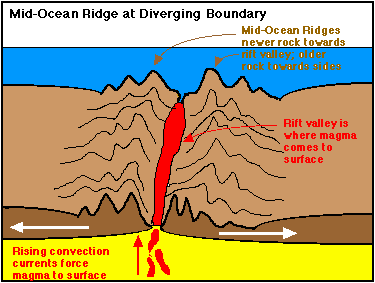
“At divergent boundaries in the oceans, magma from deep in the Earth’s mantle rises toward the surface and pushes apart two or more plates. Mountains and volcanoes rise along the seam. The process renews the ocean floor and widens the giant basins. A single mid-ocean ridge system connects the world’s oceans, making the ridge the longest mountain range in the world.
On land, giant troughs such as the Great Rift Valley in Africa form where plates are tugged apart. If the plates there continue to diverge, millions of years from now eastern Africa will split from the continent to form a new landmass. A mid-ocean ridge would then mark the boundary between the plates.”
Transform Boundaries
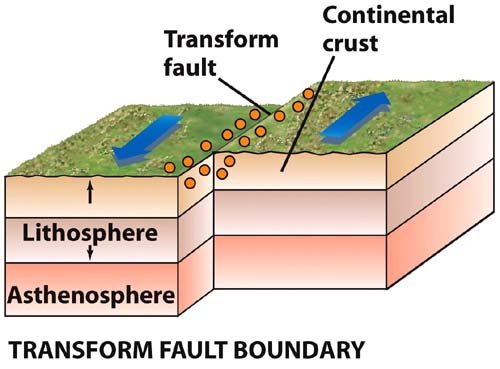
This occurs when two plates grind past each other along what is called strike-slip faults. These boundaries don’t produce mountains or oceans, but the halting motion often triggers earthquakes.The San Andrea Fault in California is an example of a transform boundary.
This marks the end of this talk, hope you found it informative and interesting. Share you thoughts, I would love to hear from you!
Until next time the talk……..continues.
References
https://www.livescience.com/37706-what-is-plate-tectonics.html
https://www.livescience.com/37706-what-is-plate-tectonics.html
 Just Talk with Lady Ann